
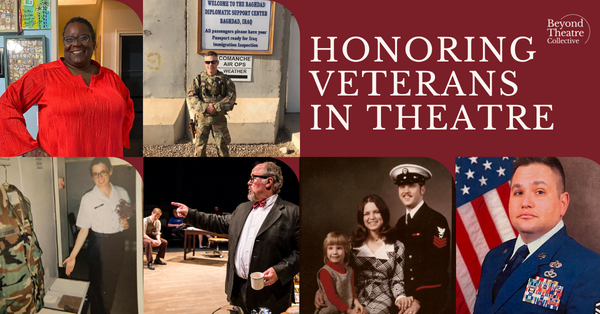
Theatre and military service may seem like two very different worlds, but both rely on discipline, teamwork, adaptability, and trust. Across community, educational, nonprofit, and professional theatre spaces, many veterans continue to serve their communities through storytelling, creativity, and collaboration. In this post, we’re highlighting six veterans who have made an impact in theatre both onstage and behind the scenes. Through acting, technical theatre, stage management, production work, and leadership, their stories reflect the unique ways military experience can shape and strengthen the performing arts community. We also take a moment to honor one theatre veteran whose legacy continues to inspire those around them.
Featured Veterans
Scroll to read or click the button to jump to a specific profile.
Lou Czarny
Woodstock, IL (1946 – 2018)
His interview is provided by his daughter, Lisa Czarny-Hyrkas.
Provide a brief outline of his experience and responsibilities.
During the Vietnam War, Lou Czarny enlisted in the Navy in 1970. After Boot Camp at Great Lakes Naval Station and Yeoman “A” School in Bainbridge, MD, Lou was assigned to the Bureau of Naval Personnel. Later, there was a staff opening in the office of the Vice-Chief of Naval Operations at the Pentagon, where Lou then served under Admiral James Holloway III for the next two years. Prior to Admiral Holloway becoming the next Chief of Naval Operations in July of 1974, Lou was assigned to Admiral Elmo “Bud” Zumwalt, Jr. (who was about to retire as the Chief of Naval Operations), in order to prepare for the change of command. Lou then spent the next four years working in the Office of the Chief of Naval Operations as the personal yeoman to Admiral Holloway, who was now the top military leader and member of the Joint Chiefs of Staff, and later was acting chairman of the Joint Chiefs of Staff. Overall, Lou served in the U.S. Navy from 1970 to 1992 with eight years of active duty and fourteen years of reserve.

What area(s) of theatre was he involved in?
In 1985, because of the need for men, Lou got talked into auditioning for The Best Little Whorehouse in Texas at The Woodstock Opera House in Woodstock, Illinois. This was his first ever musical and he was bitten by the acting bug. Over the next 30+ years he was involved in over 100 shows as an actor and all staff positions (except Director) for the Woodstock Theatre Company (WMTC), Townsquare Players (TSP), Paradise People, Woodstock Summer Theatre, Dillie’s Follies, Marengo Summer with the Arts, MarcoWoods Productions, and Gemini Players. He worked as a technical coordinator for many shows and made it rain on the Woodstock Opera House stage for the production of Singin’ in the Rain. Lou was also a former member of the Board of Directors of WMTC and TSP (now Theatre 121) and served as President of TSP, retiring in 2007.
His name lives on as the heart and inspiration of the Lou Awards, a Chicagoland theatre non-profit that recognizes quality productions of community theatre.
How did his military experience influence his work in theatre?
As yeoman in the Navy, Lou was responsible for administrative and clerical work. These experiences and skills proved very useful in his staff positions in productions and on the Boards of Directors of theatre companies.
Did he notice any similarities between military life and working in theatre?
The administrative work was similar for both Lou’s military life and working in theatre. Even performing as an actor is similar to military life because you need to follow the instructions of the director and other show staff, just as a naval service member needs to follow the instructions of his superiors.
What did being part of a theatre community mean to him?
Lou felt that being part of community theatre was like being part of another family. He met a lot of people, and many of those relationships have lasted throughout his life. There was also a merging of his own family and community theatre, as his wife, daughter, and grandchildren were very involved in theatre. In 2016, Lou’s last performance was as Jacob in Joseph and the Amazing Technicolor Dreamcoat. He greatly cherished performing in this show with his daughter and three grandchildren.
Robert “Bob” Ernst
Appleton, WI
Provide a brief outline of your experience and responsibilities.
I served in the Navy as a Personnelman, the guy responsible for keeping the lifeblood of our unit—its records, orders, and paperwork—running smoothly. I trained at Personnelman School down in Meridian, Mississippi, where I learned everything from service records to pay systems. I was stationed with Beachmasters Unit 2 in Little Creek, Virginia, a small but tight-knit amphibious operations outfit. Our job was to put the Marines and Army on the beach and keep them supplied with beans and bullets.
While the Beachmasters were out on the sand coordinating landings and moving gear, I was either protecting the communications van or back in the office, making sure every sailor’s records were squared away and that the administrative side of the mission never missed a beat.

What area(s) of theatre are you involved in?
I’m a past Chairman of the Board, and before that, I served as a Board Member and Production Coordinator for a wide range of shows. Over the years, I’ve worn just about every hat a community theater can hand out: I’ve acted onstage, worked backstage on the running crew, built sets, pulled props, and run both lights and sound.
Even now, I still audition whenever a role calls my name, and I try to help backstage wherever I’m needed. I also continue to serve in a leadership role as Past President of Attic Theatre, Inc., supporting the organization behind the scenes.
People often ask what first drew me to theater, and the answer is simple: the people. Theater gives you an instant community — a group of creative, generous, slightly chaotic souls who become your team, your collaborators, and often your friends. And there’s something about being part of a performance, whether you’re under the lights or hidden in the wings, that speaks to me. It’s the shared energy, the storytelling, the sense that you’re all building something together that exists for one moment and then lives on in memory.
How has your military experience influenced your work in theatre?
Being in the military definitely made me more confident — nothing sharpens your public-speaking skills like having to address people who can literally order you to do push-ups. That confidence carried straight onto the stage. After the Navy, stepping in front of an audience felt downright relaxing. Nobody was going to make me swab a deck if I flubbed a line.
It also trained me to handle dropped lines, surprises, and full-blown theatrical emergencies with a calm that sometimes unnerves people. Someone forgets a cue? Fine. A prop breaks? We adapt. A set piece starts wobbling, as if it’s questioning its life choices? I’ve seen worse. The military teaches you to improvise, overcome, and keep a straight face while doing it — which, frankly, is also the unofficial motto of community theater.
Have you found any similarities between military life and working in theatre?
I’ve always thought the military and theater have more in common than people expect. In both worlds, you’ve got a group of people working toward one big goal: in the case of theater it is staging a production. The military calls it a mission; theater calls it opening night. Either way, everyone’s hoping nothing explodes.
Both places have leaders in charge — directors, officers, stage managers, the occasional person with a clipboard who somehow outranks everyone. And then you’ve got the specialists: lighting people who speak in lumens, sound folks who communicate exclusively in knobs and sliders, props masters who guard their treasures like dragons, and set builders who can fix anything with hot melt glue and duct tape. That and a prayer.
What does being part of a theatre community mean to you?
I’ve found a quiet kind of joy in helping plan and organize a season — the kind of joy that comes from juggling calendars and envisioning sets and finding people to fill specific roles. And somewhere along the way, I collected a whole cast of friends and acquaintances who add more richness to my life than I thought possible.
Since retiring, the theater has become my avocation, my hobby, and, let’s be honest, a major part of my social life. Some people take up golf; I took up production meetings. Some people join a book club; I joined a group of people who argue passionately about which plays to do and whether a prop should be “period-appropriate.” And honestly, I wouldn’t trade it for anything.
Janelle Graf
Woodstock, IL
Provide a brief outline of your experience and responsibilities.
I served in the Air Force for 4 years. I was in the security forces and law enforcement and was stationed in Albuquerque, NM, throughout my enlistment. I transferred from my duties in LE to working at the armory, where I was responsible for cleaning, storing, and maintaining weapons and ammunition. Everything has its ups and downs, just like with every other job, but I really enjoyed working the night shift (usually 16+ hours) from 530pm-7 or 8am.

What area(s) of theatre are you involved in?
The last show I participated in was “Unsung Broadway” at Elgin Community College, where I sang one of the hardest songs I’ve ever sung in my life (Disneyland by Jodi Benson)! Currently, I am taking a break for health reasons. I missed singing, acting, and dancing so much during my time in. I was married to my first husband for 6 years, and we lived in Bloomington, Illinois, after my enlistment ended. I went to a community college to get my Associate in Arts degree. I was missing something in my life during those years and yearned for time back on a stage or behind the scenes in a production (I hadn’t been in anything since high school in 2003, lol). When I made the independent move back to Woodstock in 2011. I contacted friends about auditioning for shows in the local area. I did not know what to expect. I worked three jobs at the time and had absolutely no spare time to participate in any productions. Needless to say, I was very distraught for a time. It wasn’t until things calmed down in 2019 (I got remarried, moved 4 times, and was very fortunate to buy a house from 2012-2019). I finally made the jump into theatre at the Woodstock Opera House and auditioned for Mamma Mia with Theatre 121… and I made it into the ensemble!!! I’ve also dabbled in stage management and even convinced my husband to do theatre.
How has military experience influenced your work in theatre? Do you notice any similarities between military life and working in theatre?
There is a certain amount of discipline, organization, and camaraderie that goes into theatre that shares the same values as being in the service. I felt that if I could make it through my time in the Air Force, I could use those strengths to pursue something I truly love. I’ve formed so many long-lasting bonds and friendships throughout my experience in theatre since 2019.
What does being part of a theatre community mean to you?
I’ve definitely learned that adaptation is key. No experience is exactly alike, not just transitioning from the military into civilian life and then into theatre, but participating in a community that has the potential to focus on creating something truly wonderful. There is so much potential in community theatre programs where magic can be created and shared with everyone. Having been part of Theatre 121 has been a privilege. There will always be obstacles to overcome and learning experiences that come with community theatre programs, and I strongly believe that inclusivity and acceptance are absolutely essential to maintaining the shared camaraderie that drew me into the community in the first place. I am truly grateful for and proud of my experiences, and I have absolutely no regrets.
Ben Grimes
Paducah, KY
Provide a brief outline of your experience and responsibilities.
I enlisted under an Airborne Ranger contract and briefly served in the 75th Ranger Regiment as an Infantryman. After a parachuting accident, I transferred to the 82nd Airborne Division and deployed to Iraq in 2007 as part of the Iraq Freedom Troop surge. When I returned home, I was selected to attend Officer Candidate School as a Military Police Officer. I finished my active-duty time in the 93rd Military Police Battalion at Fort Bliss, Texas. I left active duty in 2014, joined the Arkansas Army National Guard, and deployed to Iraq again in 2016 in support of Operation Inherent Resolve. I will retire from the Army in January 2027.

What area(s) of theatre are you involved in?
I am the Managing Artistic Director at Market House Theatre. My career now is mostly arts administration, directing, and teaching, with very little time for acting. I have been involved in theatre since elementary school and attended a performing arts high school and a theatre conservatory in college. Before I joined the Army, I was making a go at being a professional actor in New York (on a side note, that tells you how well my professional theatre career was going). In New York, I joined the Army at 30 years old and planned to serve only one four-year contract and then use the GI Bill to attend graduate school for my MFA. Obviously, my plans changed. I returned to theatre after my last deployment as a way to deal with my own trauma from combat, and I became much more interested in the therapeutic nature of theatre and how the art form can elicit positive changes in communities.
How has military experience influenced your work in theatre?
My experience as an officer has been vital to my feeling comfortable stepping into administrative leadership positions. Also, much of my work centers on applied theatre for veterans and other at-risk communities.
Do you notice any similarities between military life and working in theatre?
So many! Since I was older when I enlisted and had spent the greater part of a decade living on my own, I think I had a unique perspective. One observation I made was that soldiers and theatre people have a lot in common. We both believe in serving something greater than ourselves, in ensemble and teamwork, and both groups sacrifice their own personal lives in pursuit of these ideals.
What does being part of a theatre community mean to you?
I believe that theatre is vitally important now more than ever before. Live theatre is one of the few art forms that AI cannot replicate, and in such divisive times, when we all retreat into social media echo chambers, theatre challenges us to sit in a dark room with our neighbors and celebrate empathy and humanity.
Anita Praver Harvell
Watertown, NY
Provide a brief outline of your experience and responsibilities.
Signal Corps Lieutenant — 1986–1990
Served in Mainz, Germany as an avionics platoon leader in I Company, 4th Aviation Battalion, 8th Infantry Division. Responsibilities included supervising a platoon of avionics repair soldiers, ensuring maintenance readiness, and supporting aviation operations.
Maintenance Officer (Captain), U.S. Army Reserve — 1990–1996
Oversaw maintenance operations in California, managing equipment readiness, logistics coordination, and technical oversight across reserve units.
Detachment Commander (Captain), 155th Supply & Services Battalion, U.S. Army Reserve — 1996–2001
Commanded a detachment in Liverpool, NY, responsible for personnel leadership, training, supply operations, and overall mission execution within an S&S battalion.

What area(s) of theatre are you involved in?
I was in my first show in fifth grade in a short play (I wasn’t very good, but it was fun). My next role was a walk-on as a nanny that I got only because I wasn’t afraid to have a mouse dropped down the back of my costume.
I was a shy, outcast kid. We had forced bussing in the 70’s, and we moved a lot, so I spent a lot of time at schools away from my neighborhood, or we moved before I could feel comfortable anywhere. Theater was a place where I could be “someone else” and fit in somewhere.
I wear many hats in theater. First, I’m an actor and have been in numerous musicals, straight plays, and even improv. On the technical side, I have been a stage manager and involved with production/company management. I also play in pit orchestras and have been on the Board of Directors of two different community theaters.
How has military experience influenced your work in theatre?
Leadership, organizational skills, collaboration to make something happen, and flexibility are all key traits in the military that translate 100% to the theater. I met my husband while working as a sound tech/designer for the musical Company in Germany (he was in the pit orchestra). We have shared a common love of theater for almost 35 years.
Do you notice any similarities between military life and working in theatre?
The camaraderie within a military unit and a theater company is similar in they are the key to a successful production. As a maintenance officer, who has also deployed on maneuver and deployment exercises, logistics of moving units across the country (and the world), load-in/load-out planning, etc. are exactly what stage managers and company managers do on the regular. Being calm in chaos is an Army trait-it just translates to theater.
Theater companies — especially community and regional ones — often struggle with structure, communication, and operational consistency.
My Army background adds the creative passion to the organizational rigor and structure that the Army already provided – the cherry on top, so to speak – which lends itself to my experience across artistic, technical and governance roles.
What does being part of a theatre community mean to you?
It’s my saving grace – and been a part of my identity longer than many other things in my life.
It is where I feel I belong – it’s my home
It allows me to give back and continue to serve, just like the Army
It allows a very left brained person (I am an engineer/IT person by profession) a right-brained, creative outlet
It allows me to lead with empathy – not only guide people, but expand the collaborative efforts you don’t always get to fully exercise in a military environment
It allows me to continue to grow and develop new skills – any actor or SM who doesn’t learn anything every show isn’t trying hard enough
It allows me to take risks and be open to new things
If I had to summarize all of that, “Being part of a theatre community now means belonging to a creative family where collaboration, service, and storytelling come together. It gives me a place to lead, to learn, to support others, and to express myself in ways that complement my military background. It is my home where I find connection, purpose, and joy.”
Joshua Rosenberg
Wichita, KS
Provide a brief outline of your experience and responsibilities.
I served 23 ½ years in the Air Force. My first six I was a Combat Weather Forecaster and provided weather support for Army aviation units. The following 17 ½ years I was an Emergency Manager, which peacetime provided planning, preparation, response and recovery for all hazards, from aircraft accidents to pandemic response. Wartime, we were the CBRN (Chemical, Biological, Radiological, and Nuclear) defense specialists. We spent a lot of time training and briefing in front of crowds of all sizes.

What area(s) of theatre are you involved in?
I perform with a few groups around Wichita, doing both standard theater as well as improv-heavy murder mystery dinner theater. I’ve also operated the light board for several shows when I needed a break from being on stage. I was initially drawn to theater because when I was 13 I realized my chances of being the next Michael Jordan were slim, and I overheard a girl I had a crush on talk about auditioning for the school play. I’ve loved performing ever since.
How has military experience influenced your work in theatre?
One major aspect of my military experience that has influenced my theatre work is the importance of unit cohesion. When a team puts in the work to get to know and trust each other, it brings out the best in performance, especially in improv. I have seen partners who can give me a look, and I know they’ve got an idea for a bit, and they trust me to support them in getting to the punchline.
Do you notice any similarities between military life and working in theatre?
The military is a lot more progressive than most civilians think. A good leader in the military knows how to bring people from all walks of life together, identify their strengths and weaknesses, and mash them into a team that can perform! Same as a good director. People with fixed mindsets who can’t get past their biases rarely go far.
What does being part of a theatre community mean to you?
Being part of Wichita’s theatre community means I have found a place where I can be myself, while still serving in a different capacity. A good performance is any performance where I’ve made an impact on someone, whether it’s making them laugh after a rough week, cry because I connected them with a memory of a family member, or think about something that challenges their beliefs.


Leave a Reply